3.02.2011

Spring awakening


Spring time at Campbell means two things: engagements and outdoor activities. While we can't say much about the first one, a few new programs and events are quickly filling the spring semester calendar.

In a time when federal support of service may soon be a thing of the past, Campbell's dedication to service is an example of how the private and faith-based sectors can step up and continue traditions of outreach and compassion.

Check out what's on the menu for spring time service at Campbell, in chronological order:

Abrazo isn't an event but a sustainable program designed to connect Campbell students with local farm worker camps through the NC Farmworkers Project. Student groups (clubs, dorms, etc.) volunteer to support a camp of farm workers to meet its needs.
Click here to find Abrazo on Facebook.
Caring Camels is another long-term program with a mission to place Campbell volunteers into the community. In its second semester the program currently has five tutors and one mentor serving dozens of hours each month at local schools. 
Alternative spring break outreach to Red Springs, NC and Charleston, WV will address rural poverty. Keep up with Service at Campbell for posts and photos!
Impulse coffeehouse and the Multicultural Council are co-sponsoring an open-mic night for performances representing students' nationalities and also to showcase international poverty. March 29 at 8 p.m. in Turner.

Poverty Awareness Week will bring representations of poverty to campus to remind us how prevalent it is and what we can do about it.
Click here to read the post about #CampbellPAW2011.


Operation Inasmuch 2011 in its fourth year at Campbell and ready to be the best one yet! The day-long blitz of service on April 16 will touch lives all over Harnett County.
Click here to find OIAM 2011 on Facebook. Sign up here.
As you can see there's no shortage of ways to get connected, and the only place to go is up! Next semester will feature bigger, better ideas to help our students service the Campbell community.

Last but not least, follow us on Twitter as CUservice!

2.21.2011

Poverty Awareness Week at Campbell


Did you know there's a trailer park adjacent to Campbell's campus? Beyond that, 17% of Harnett County lives in poverty. We're going to discover a lot more about poverty during Poverty Awareness Week at Campbell, April 4 - 8 on campus and in the community.

Posters will go up around campus listing the general events for the week and details of those events are below. For more information, e-mail Sara Acosta, AmeriCorps VISTA in the Office of the Campus Minister.

Note: Joining the Facebook event does not mean you've officially signed up. Use this online form.

Monday, April 4 
CUW: Hugh Hollowell Words from founder of Love Wins Ministries
Location: Turner Auditorium     
Time: 10 – 11 a.m.     
           
Faces of hunger Statistics about poverty posted around campus
Location: various classrooms         
Time: All day throughout the week
             
Letter writing campaign begins Address poverty with Congress
Location: Student Center               
Time: 10 a.m. – 6 p.m. all week
                
Tuesday, April 5
Service event: Beacon Rescue Mission Share humanity. 
Location: Dunn
Time: 2 - 4 p.m. (subject to change) 


FreeRice.com challenge How smart are you? 
Location: tables outside Student Center           
Time: 10 a.m. - 6 p.m.
**The winner of the challenge receives two free passes to Smithfield Cinemas! 

Toms’ A Day Without Shoes Feel what it's like to go without shoes.  
Location: whole campus              
Time: all day
**Please carry a pair of shoes with you in case a professor request you wear shoes.   Also, remember you MUST wear shoes in all the food locations on campus.

Wednesday, April 6
CUW: Interview with Hugh Hollowell
Location: Turner Auditorium          
Time: 10 – 11 a.m.


School of Pharmacy Health Fair
Location: Student Center Courtyard
Time: 12:30 - 2 p.m.
            
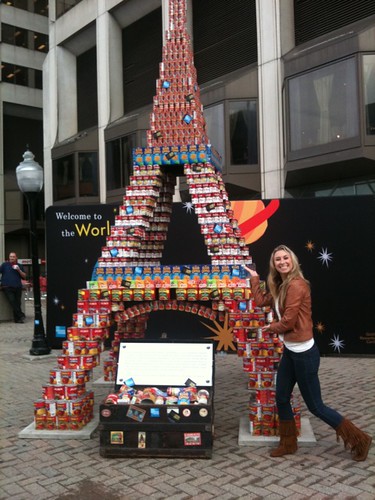
Can tower challenge Can your group build a landmark out of cans?
Location: Academic Circle
Time: 3 – 5 p.m.

Thursday, April 7
Day of prayer Sometimes the only thing you can do is tell God.
Location: prayer room in Dinah Gore bell tower
Time: 8 a.m. – 8 p.m.
           
Friday, April 8
Social media blitz Tell your friends and followers what you learned. 
Location: the Internet
Time: 24/7


2.10.2011

You are a piece of the pie: thoughts from a conference

You learn something new every day. In the case of Campbell's service learning staff, we learned a lot of new things yesterday.

Three professors and I attended the annual PACE (Pathways to Achieving Civic Engagement) Conference at Elon University. It's an opportunity for service learning professionals at NC Campus Compact member schools and their VISTAS to come together and share ideas about service learning. Think of it as a one-day think tank about service learning in higher education.

Leaders in higher education and service learning veterans shared remarkable words on the future of higher eduation and how vital service is to its survival. We heard a lot of anecdotes, statistics, and goals, but what I took away from the day was this: each student at each school is a piece of the pie. Pie is just a metaphor because I think everyone likes pie, but what I really mean is that each student at each school has a part to play in making the world a better place. I don't mean a fuzzy wuzzy "better place" where everyone hugs everyone for no reason and we all color before going to work in the morning. I mean a "better place" that accomplishes social justice, feeds all of its kids every day before school, and has recycling bins at each restaurant.

We learned about service efforts (service learning and community service) from different independent universities, public universities, and community colleges. Some concepts are working for them that we might practice, just as we're doing a few things they might benefit from. Everything in history started with someone testing out an idea.

I help myself understand concepts with pictures, so during one of the speeches I decided that the results of service function as the ripples in a pond. An act of service lives far beyond the time we spend serving, its legacy working outwards away from the person who first performed the act of service. If you've seen the tear jerker "Pay It Forward," you know what I'm talking about.

For someone with a lot of compassion or zeal to help others, wondering where to start can be daunting. Natural volunteers might want to fix everything with their efforts but realistically can only help one breath at a time. So, where does one start? Where you're most needed. Serving food at a shelter or reading to at-risk third graders isn't going to alleviate world poverty or put a plug in the O-zone between now and lunch time tomorrow, but those acts of service will start a powerful ripple effect that will pulsate through you and those who see and experience your service. Maybe some day your actions will lead to solving global issues. You have to start somewhere.


What act of service will start your ripple effect?


2.01.2011

Poverty Awareness... say what?

It's been six months since Campbell designated a staff member to organize and enhance service efforts on campus. While we're constantly learning and finding new and better ways to operate, this is an overview of what's happened and a preview of spring semester fun:

  • 9/11 Day of Service
  • Caring Camels tutoring placement program
  • Strengthening community partnerships
  • MLK Day of Service grant from NC Campus Compact
  • MLK Day of Service
  • Poverty Awareness Week
  • Alternative spring break/mission trip to Charleston, WV
  • Development of service learning classes 
 Those are the most palpable representations of service at Campbell, but of course the work behind the scenes is constantly buzzing also. The graduate schools take part in service, professors have been doing service learning for a while and some are just getting started. Conferences, webinars, newsletters, and listserv messages are all part of what's turning into something powerful. Not to mention the new First Year Experience program that will also encourage service!

What is Poverty Awareness Week, you ask? I'll be happy to tell you all about because it's going to be fun and enlightening. The idea behind PAW is to bring representations of poverty to the campus in order to educate the university community what poverty is, what it looks like, and what college students can to do fix it.

The dish:
  • April 4 -8
  • All events are on campus except a service project
  • The events will be creative, interesting, and informative 
  • We want your ideas! So far we have a can tower challenge, a day of prayer, etc. What do you want to teach your peers about poverty?  E-mail me to tell me your ideas!
How will you reach out this semester?


1.14.2011

Martin Luther King the Christian

No human can fully fathom the presence of God in another. In the case of Martin Luther King, all we can do is gather the information we have at hand and paint a picture of how his faith might have influenced his time on Earth.

It's no secret that MLK was a pastor and the son of a pastor. Jesus was not a stranger in the the household of King's childhood, nor in his adulthood. Living generations have relatively few first hand, concrete accounts of Dr. King's faith. We can assume he believed in personal salvation. We can assume he read the Bible front to back, and we can assume he prayed before every meal. But those tenets of mainstream Christianity didn't propel MLK's work. Instead, it was the life of Jesus that sparked MLK's passion. Mainstream Christianity teaches love because Jesus lived it, and MLK sought to do the same.


Love for MLK, like the rest of us, took many forms in his life. He loved his wife. He loved his children. He loved justice, willing to put his needs aside in order to assert it whenever possible. In MLK's writings, "love" and "justice" pop up frequently, as in an excerpt from his 1963 "Letter from Birmingham Jail":

"But as I continued to think about the matter, I gradually gained a bit of satisfaction from being considered an extremist. Was not Jesus an extremist in love? ...  So the question is not whether we will be extremist, but what kind of extremists we will be. Will we be extremists for hate, or will we be extremists for love? Will we be extremists for the preservation of injustice, or will we be extremists for the cause of justice?"
Martin Luther King lived a very public life in adulthood as he eventually became known around the world. He preached renowned sermons that still echo today. Despite what we could call his famous faith, his faith was actually rooted very deeply and privately. A religious studies professor at Vanderbilt University told the Houston Chronicle that prayer was essential to MLK's fight for racial justice amid threats and challanges.
"He writes that 'prayer was King's secret weapon in the civil rights movement,' a key to its success as people found the strength to continue despite arrests and killings."
It seems King grew his faith inwardly until his body could no longer hold its potential, and he had to express to the world what he felt and what God sent him to do. He expressed it at segregated lunch counters, at the Lincoln Memorial, on the streets of Montgomery, and in the pulpit.

So, where has your faith been, and where has mine been? Mine's been to eastern Europe and a couple U.S. states. Maybe your faith is still humming inside you, growing and budding silently. Martin Luther King's faith left its mark wherever he went. Maybe you don't consider yourself a so-called person of faith--do you make a place more englightened by being there, or a person more englightened by having a conversation with them? MLK didn't bust out the philosophical big guns to inspire. He used small words with big implications. Like "love."

MLK in deep thought while in the Birmingham jail.


1.06.2011

Martin Luther King the father

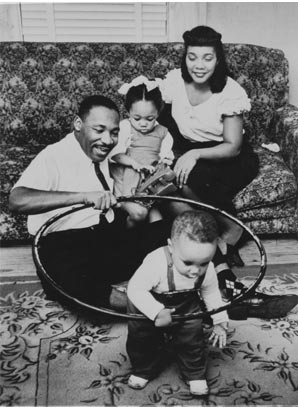
Typical images of the American dad: learning how to play catch, cringing at the first diaper change, the awkward Christmas sweater. But what if your dad was the leader of a national movement and a celebrity of history? Your family photos might look a bit different.

Research about Martin Luther King yields little information about his marriage and family, other than that he and Coretta married quickly and eventually had four children. When their father fell to a sniper in 1968 the children were between the ages of 5 and 13, all old enough to have memories of their dad and to feel the sudden and wrenching void. 

Black and white photos of the King family, some more on the cute side and some more poignant, dot the Internet and history books among the myriad photos of protests and speeches. Despite the King children being underrepresented in history, however, any even half-decent father would tell you that his family was the foundation of his life. Coretta was there before the marches and speeches, and their children were a result of one of the purposes she and Martin felt for their life together.

In 1957 when their oldest child Yolanda was just two years old and Martin Luther King III was just two months old, Dr. King traveled more than 700,000 miles and spoke 208 times. The following year King published his first book, "Stride Toward Freedom," all while pastoring in Atlanta and then at his father's church in Birmingham. He was a busy man to say the least, not unlike many dads today. 

We don't see many photos of MLK in his home, but I doubt he remained in a suit, preaching to his children. He changed into jeans, asked his children about their day at school, discussed the checking account with Coretta, and changed the channel when news of the latest civil rights violence broke. He was a dad and a man like any other, just with a purpose different from most.

The children grew up well loved by all accounts, but amid threats to the family (some actualized), civic turmoil immediately around them, and with a dad whose heart was in two places-- on the streets of America fighting for equality, and on the sofa of the King family home reading bed time stories and giving hugs. No parent wants to have to choose between anything and their family, but MLK understood the implications of his work and trusted that the faith that brought him to "the mountain top" would also bring his family through any pain they felt in his absence, before or after death.

The lesson of MLK's fatherhood isn't that every man can be a civil rights hero and successfully raise four children. The lesson isn't in the life he lived but in the sacrifices he (and Coretta, equally as much) made for the King family. He gave up memories with his children, a steady pay check, and seeing is wife every day because he knew it was the right time to fight for his dreams and the dreams he held for the rest of America. Should you push your family aside to pursue the goals you've made for yourself? No, but fulfilling your purpose is why you're here, and you shouldn't let anything get in your way.


Information source: The Seattle Times, "Timeline: Martin Luther King, Jr."

12.30.2010

Martin Luther King the learner

When was the last time you considered yourself a student? College students of my generation are just finishing up their degrees and I can't believe that kids born in the 90s are in college already. Regardless of when you graduate from any stage of your education, you are still learning, whether you know it or not.

Martin Luther King was a student of life. He studied it, lived it, pursued it. His formal education began in the public schools of Atlanta and turned into a series of lily pad jumps to college where he absorbed the philosophies of Gandhi, studied theology, grew in his faith, and began to feel a burden for social justice.

Outside the walls of institutions MLK learned the patterns of American life on the black side of the fence. He also learned to question-- to question those patterns, why they exist, and what forces could break those patters. Learning propelled MLK from a position of waiting for change to happen to a position of making change happen.

After spending the first few years of his life in four different schools, including two different high schools, outstanding college entrance scores and a government program to fill America's universities during WWII landed him in Morehouse College at the age of 15. I won't give you the run down of the rest of MLK's schooling, but you should know that between the ages of 19 and 26 (years 1945 - 55) he received two bachelor's degrees, one in sociology and one in divinity, and a doctorate of philosophy in systematic theology.

If MLK's areas of study tell us anything, it's that humans intrigued him-- their behavior (sociology) and interaction with God (divinity). His thirst for knowledge about both topics came to a head with his leadership in the Civil Rights Movement. He offered answers as to why so many humans condone racism (sociology) and what God has to say about it (divinity). And to complement both areas perfectly was King's philosophical anchor, Gandhi, and his ideas of nonviolent resistance.

There's no telling exactly all the information MLK learned over the course of his short life. Our only sources for what we know today are his speeches, writings, and accounts of his contemporaries. But Dr. King didn't grow up learning just sermon writing and history. Along the way he learned how to tie his shoes, how to do long divison, how to politely introduce himself, and how to find a seat at the back of the bus. Just like you and I, he also picked up patterns and symbols that socialized him into a "normal" American, as normal as you can call MLK.

What does this have to do with you? You're a learner just as Martin Luther King was. He determined what kind of learner he would be, and you and I have the same choice. Without the pursuit of more knowledge our worldview and understanding will never grow and our ability to spark change will be stunted as a result. That doesn't mean listening to the evening news every night this week will bring world peace, but it's a good beginning to pursuing life just as MLK did.


Dr. King based his movement of nonviolence on the teachings of Gandhi, pictured on the wall.


Information source: Lousiana State University, "Martin Luther King. Jr.: A biographical sketch"